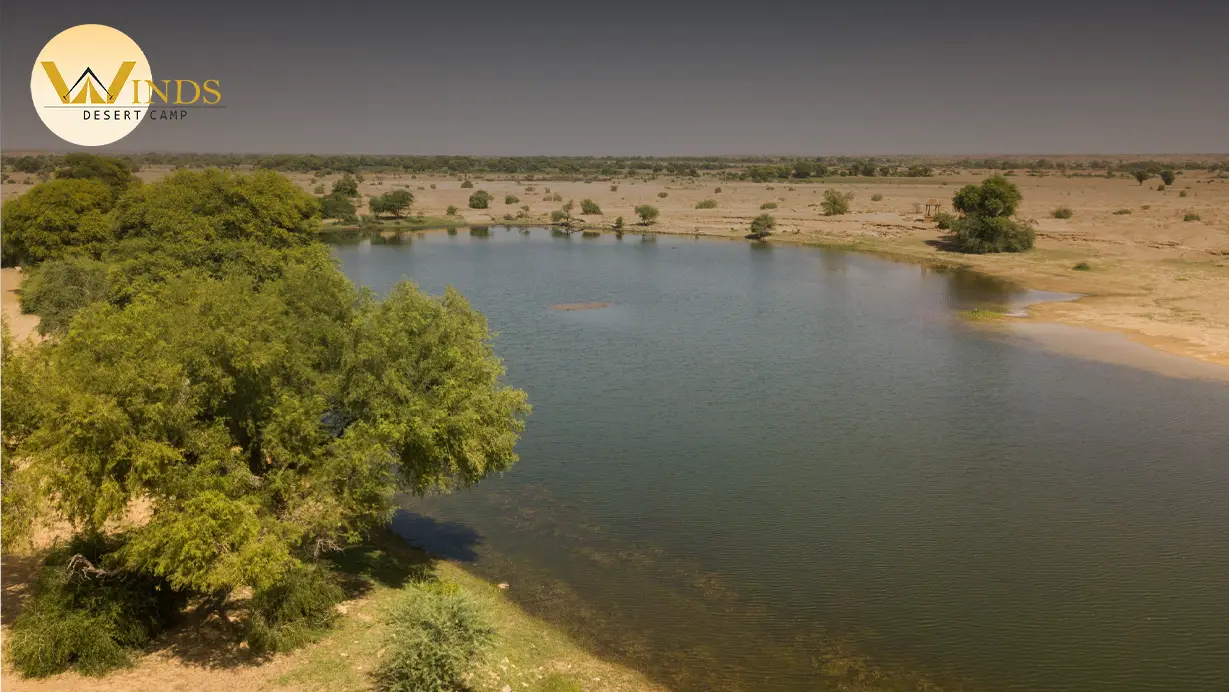
Desert National Park in Jaisalmer is a 3,162 sq km protected wilderness in the Thar Desert, the only place in Rajasthan where all four state symbols are found naturally in the same landscape, and the last significant stronghold of the critically endangered great Indian bustard, with fewer than 150 individuals remaining in the wild. Most visitors arrive expecting dunes and leave having seen something they did not expect: a living grassland ecosystem teeming with raptors, gazelles, desert foxes, and if the season is right, a godawan standing in the open at dawn with nothing behind it but the desert horizon.
This desert national park guide covers everything you need before visiting, from entry fees and safari timings to what the landscape actually looks like and why guests who stay in desert camp near Sam Sand Dunes have a significant advantage over those staying in Jaisalmer city.
What Is Desert National Park Famous For?
The standard answer is the great Indian bustard. The real answer is more specific.
Desert National Park is famous for being the only location in Rajasthan where all four state symbols coexist naturally:
- Great Indian Bustard (godawan) — state bird, one of the heaviest flying birds in the world
- Chinkara (Indian gazelle) — state animal
- Khejri tree (Prosopis cineraria) — state tree
- Rohida flower (Tecomella undulata) — state flower
The GIB story: The godawan once ranged across much of the Indian subcontinent. Fewer than 150 survive in the wild today — down from thousands within living memory. Power line collisions, poaching, and habitat loss drove the collapse. Project GIB, a government conservation programme, operates within the park with breeding centres and habitat management.
When you see a great Indian bustard at DNP, you are not seeing a bird. You are seeing one of the last 150.
The Landscape: Not What Most Visitors Expect
Here is what surprises almost every first-time visitor: only 20% of Desert National Park is sand dunes.
The remaining 80% is open grassland, rocky outcrops, compact salt lake beds, and thorny scrub. That is where the wildlife lives. The dunes are dramatic. The grassland is where your safari time goes.
The park in numbers:
- Total area: 3,162 sq km (1,900 in Jaisalmer, 1,262 in Barmer)
- Established: 1980
- Internal water bodies: Rajbaugh Lake, Milak Lake, Padam Talao
Geological context: The park holds Jurassic-era fossil evidence — 180 million years old. This desert was once a tropical forest, before that an ancient sea. The Akal Wood Fossil Park, 17 km from Jaisalmer, preserves fossilised tree trunks from that era and pairs naturally with a DNP safari visit.
Wildlife Guide: What You Can See
The wildlife here is not what most Indian wildlife destinations offer. The species are desert-specific, often cryptic, and require patience and the right guide to find. That makes a sighting here feel earned in a way that a roadside tiger encounter sometimes does not.
Birds – 250+ species recorded:
- Great Indian Bustard: October–February, grassland near Sudasari; observe from a distance — flushes easily
- Laggar falcon, steppe eagle, black-shouldered kite: regular morning sightings
- Sandgrouse: large flocks at dawn
- Larks (multiple species), harriers, kestrels, vultures
Mammals:
- Chinkara: most commonly sighted – alert, quick, the classic DNP mammal
- Desert fox: crepuscular; best at dawn and dusk
- Desert cat: elusive; evening and night safaris
- Nilgai, blackbuck, desert jird
Reptiles:
- Spiny-tailed lizard: basks on rocky ground in morning sun
- Desert monitor lizard: large, near water
- Saw-scaled viper: nocturnal — watch where you step on night safaris
Desert National Park Jaisalmer Timings
The park operates across three daily safari slots, a flexibility rare among Indian national parks.
Safari slots:
- Morning: Approximately 6:00 AM departure – best for raptors, GIB, and small birds
- Evening: Approximately 4:00 PM departure – best for mammals, golden desert light, photography
- Night: After dark – for nocturnal species; requires a special permit
Important: These are guide timings, not fixed gate-opening hours. The park spans 3,162 sq km and does not function like a gated tiger reserve. The primary entry point for wildlife safaris is Sudasari Checkpost, and safari timings are coordinated through the forest department office there.
Verify current slot timings at Sudasari on the day of your visit. Timings published online across competing sources vary significantly and may not reflect current forest department scheduling.
Desert National Park Jaisalmer Entry Fee
Published fee data conflicts across sources. Here is what multiple sources most consistently report:
| Category | Fee (Most Cited) |
| Indian nationals (per person) | ₹50–₹100 |
| Foreign nationals (per person) | ₹₹300–600 |
| Guide fee | Around ₹200 |
| Jeep safari (per vehicle/day) | ₹1,500–₹5,000 (may vary depending on the tour operator) |
Honest note: The Indian national entry fee appears as ₹50 in some sources and ₹100 in others. Given that this is a government-managed park with periodically revised fee structures, treat any published figure, including this one, as a starting point and verify at Sudasari gate on arrival.
On the guide fee: The ₹200 guide fee is one of the best investments you will make at DNP. A local naturalist guide does not just drive — they read the landscape. They know which areas the GIB has been feeding in this week. They hear a laggar call before you do. They know which rocky outcrop the monitor lizard returns to every morning. A driver who completes your permit and takes a standard route is a different service from a naturalist who makes the desert legible.
Jaisalmer to Desert National Park Distance
From Jaisalmer city: 40–45 km to Sudasari Checkpost – the main wildlife entry gate.
Navigation note for first-time visitors: When using Google Maps or similar navigation tools, search specifically for “Sudasari Gate, Desert National Park” rather than the park name alone. The park covers 3,162 sq km, and navigation apps frequently point to different boundary points depending on how you search. Sudasari is where the forest department office and permit counter are located, and this is where you start.
Drive time: Approximately 1 hour from Jaisalmer city, depending on road conditions.
From Sam Sand Dunes: 5–10 km.
This is the most important distance figure for guests at Winds Desert Camp. Sam Sand Dunes falls within or immediately adjacent to the Desert National Park’s designated area. Guests staying at Sam wake up inside the park’s ecosystem. The grassland and dune landscape surrounding the camp at dawn is a DNP landscape. Morning birds overhead are the same species you are paying a jeep to find.
For a safari, guests at Sam reach Sudasari in under 15 minutes. Guests staying in Jaisalmer city drive an hour each direction. That difference shapes the entire morning experience.
The Night Safari: DNP’s Rarest Experience
Most Indian national parks prohibit night safaris. Ranthambore, Corbett, Bandhavgarh — all closed after dusk. Desert National Park permits them, which makes it genuinely unusual in the Indian wildlife landscape.
What the night desert shows:
- Desert fox: Hunts actively after dark, visible in jeep headlights crossing open ground
- Desert cat: Elusive by day, occasionally spotted at night on sandy tracks
- Indian hedgehog: Surprisingly common along the edges of scrub and sand
- Barn owl and Indian eagle-owl: Both active after sunset, the eagle-owl particularly large and striking
- Reptiles: Nocturnal snakes and lizards emerge after the ground cools
Night safari notes:
- Carry a torch with a red filter – red light disturbs wildlife far less than white light
- No flash photography on night safaris; it stresses nocturnal species and ruins your own night vision
- Allow 15 minutes after the jeep engine cuts off to let your eyes adjust fully – the desert is never completely dark, and much becomes visible once you stop looking through headlights
- Saw-scaled vipers are active at night on warm sandy ground; be aware of where you step if you leave the vehicle
The Akal Wood Fossil Park – Geology and DNP Combined
Seventeen kilometres from Jaisalmer on the Barmer road, Akal Wood Fossil Park preserves fossilised tree trunks from 180 million years ago lying exactly where they fell when this desert was a tropical forest. The context this gives a DNP visit is significant. The godawan, the chinkara, the desert fox- all of this life has emerged from a landscape that was once a sea, then a jungle, and is now this desert.
Practical combination: Akal in the morning (1 hour) + DNP afternoon/evening safari from Sudasari. Both sites sit on the same general road from Jaisalmer – clean, unhurried, single-day route.
Best Time to Visit Desert National Park
| Season | Temperature | What This Means |
| October–February | 5–25°C | Peak season. GIB is most visible, migratory birds arrive, and all mammals are active. Cold before dawn — bring layers |
| March–April | 25–38°C | Productive through March. April starts getting hot |
| May–June | 40–48°C | Extreme. Dawn visits only. Reptiles active. Not recommended unless specifically targeting summer species |
| July–September | 30–38°C, humid | Monsoon turns grassland green. GIB harder to find. Birds more diverse |
GIB-specific window: October to February, near Sudasari. This is when the birds congregate in the grassland in open, viewable conditions.
What to Pack
Most important item – read this before the rest:
Neutral, earth-toned clothing. Khaki, beige, olive green, brown. The great Indian bustard is acutely sensitive to movement and contrasting colour in open grassland. Brightly coloured clothing increases the chance of spooking the bird before you have positioned for a view. This applies equally to chinkara, desert fox, and other skittish species. At DNP, what you wear materially affects what you see.
The rest of the list:
- Binoculars (8×42 minimum — non-negotiable for a bird park of this type)
- Camera with a long telephoto lens (400mm minimum for bird photography; 600mm preferred for GIB at distance)
- Layers in winter — temperature can be 5–8°C before dawn and 22–25°C by 10 AM; layers you can remove mid-safari quietly
- Water — minimum 2 litres per person per safari slot; oral rehydration salts in summer
- Torch with red filter for night safari
- Scarf or buff for dust on open jeep tracks
- Snacks — no refreshment facilities near Sudasari
- First-aid kit and personal medications – nearest pharmacy is in Jaisalmer city
Stay at Winds Desert Camp – Your Desert National Park Base
Sam Sand Dunes is not near Desert National Park. It is inside it.
Guests at Winds Desert Camp wake up in the park ecosystem. The birds overhead at 6 AM are DNP birds. The fox that crosses the dune edge at dusk is a DNP fox. A morning jeep safari from Sam reaches Sudasari in under 15 minutes — leaving time for two productive safari hours before the heat builds.
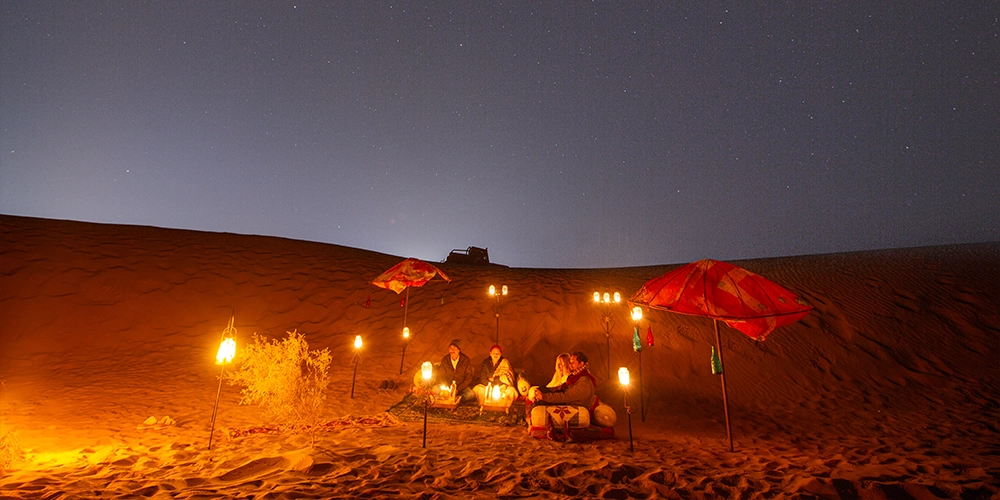
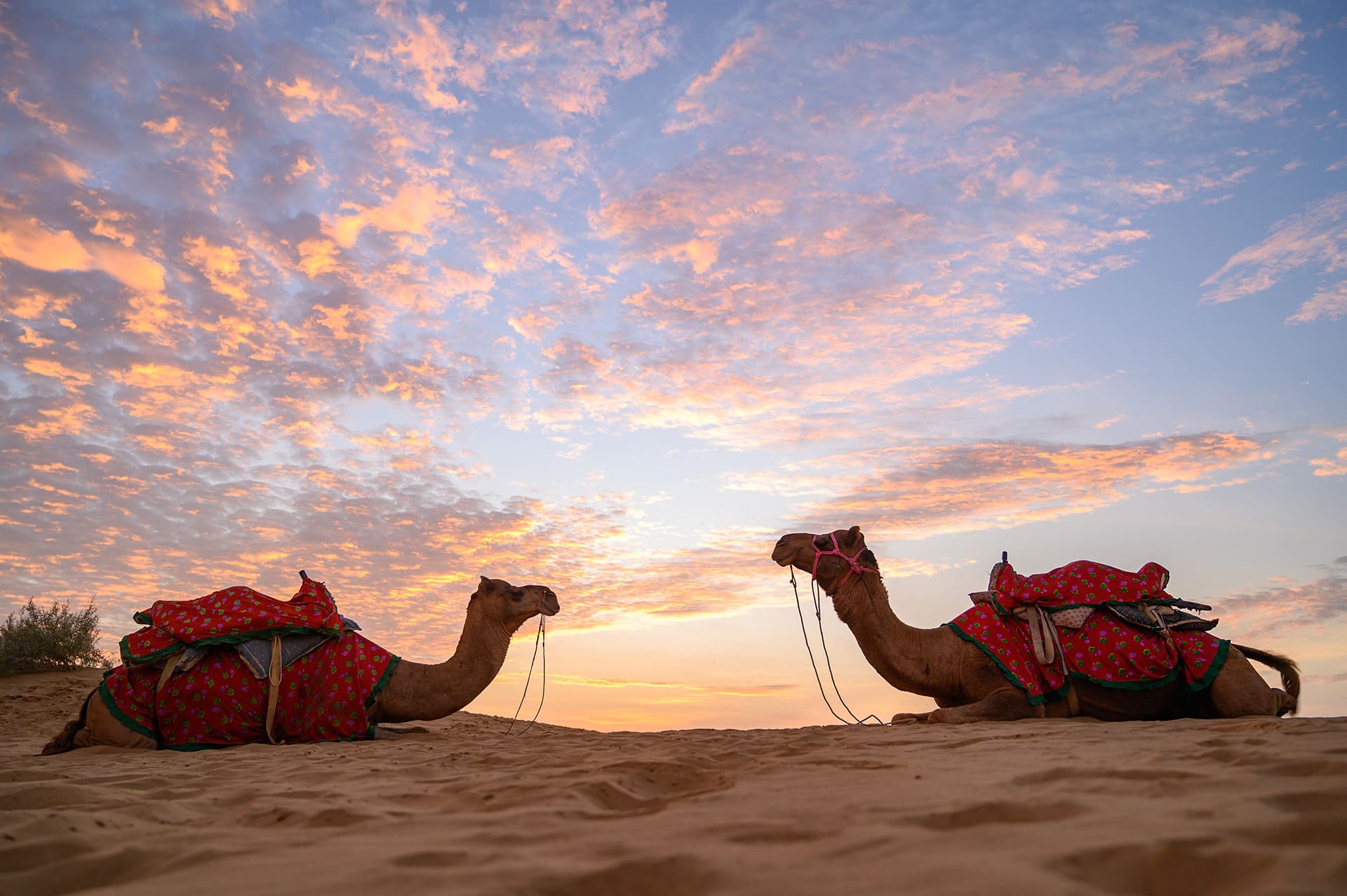
The desert camp in Jaisalmer sits on 3 acres of private dunes with 500 feet of frontage. 25 tents, including AC king tents and cooler tents. Camel safari at sunset into the same dunes the godawan crosses. Cultural evenings with folk music. Rajasthani dinner under the desert sky.
FAQs
Q. What is Desert National Park famous for?
Ans. Desert National Park is most famous for the great Indian bustard, one of the world’s heaviest flying birds and among India’s most critically endangered, with fewer than 150 individuals remaining in the wild. The park is also the only location in Rajasthan where all four state symbols are found naturally together: the great Indian bustard (state bird), chinkara or Indian gazelle (state animal), khejri tree (state tree), and rohida flower (state flower). Beyond the GIB, it is one of India’s most important desert wildlife habitats with 250+ bird species, diverse mammals, and a unique grassland ecosystem, only 20% of which is actually sand dunes.
Q. What are the Desert National Park Jaisalmer timings and how do I book a safari?
Ans. Safaris are conducted across three daily slots — morning (approximately 6:00 AM), evening (approximately 4:00 PM), and night (after dark with a special permit). The park does not operate like a standard gated reserve. The primary entry point is Sudasari Checkpost, where forest department permits are issued. Book through the Sudasari forest office or arrange through your accommodation. Given that published timings across sources conflict, verify current slot timings directly at Sudasari before your visit. Guests staying at Sam Sand Dunes are approximately 10 km from the gate, significantly closer than Jaisalmer city visitors.
Q. What is the Desert National Park Jaisalmer entry fee?
Ans. The most commonly cited entry fee is ₹50 to ₹100 for Indian nationals and ₹300 for foreign nationals. A government guide costs approximately ₹200 and is strongly recommended over a driver-only arrangement; local naturalist guides significantly increase sighting probability, particularly for the great Indian bustard. Jeep safari costs range from ₹2,000 to ₹5,000 per vehicle per day depending on route and duration. Published fee data varies across sources; verify current rates at Sudasari Checkpost on arrival.
Q. How far is Desert National Park from Jaisalmer and from Sam Sand Dunes?
Ans. From Jaisalmer city: 40–45 km to Sudasari Checkpost, approximately 1 hour by road. When navigating, search for “Sudasari Gate, Desert National Park” specifically; the park spans 3,162 sq km, and navigation apps may point to different boundary entry points. From Sam Sand Dunes: 5–10 km. Sam falls within or immediately adjacent to the Desert National Park area, which means guests staying at Sam, including at Winds Desert Camp, are already inside the park ecosystem and can reach Sudasari in under 15 minutes.